



- Marjorie Taylor Greene led a packed, emotional protest against a proposed Vanguard Renewables bio-waste digester in Murray County.
- County commissioner Noah Bishop withheld reaffirmation, pausing the $20 million project; Georgia EPD put permitting on indefinite hold.
- Concerns include daily semi traffic, groundwater and air risks, and potential protected bald eagle nest investigations halting development.
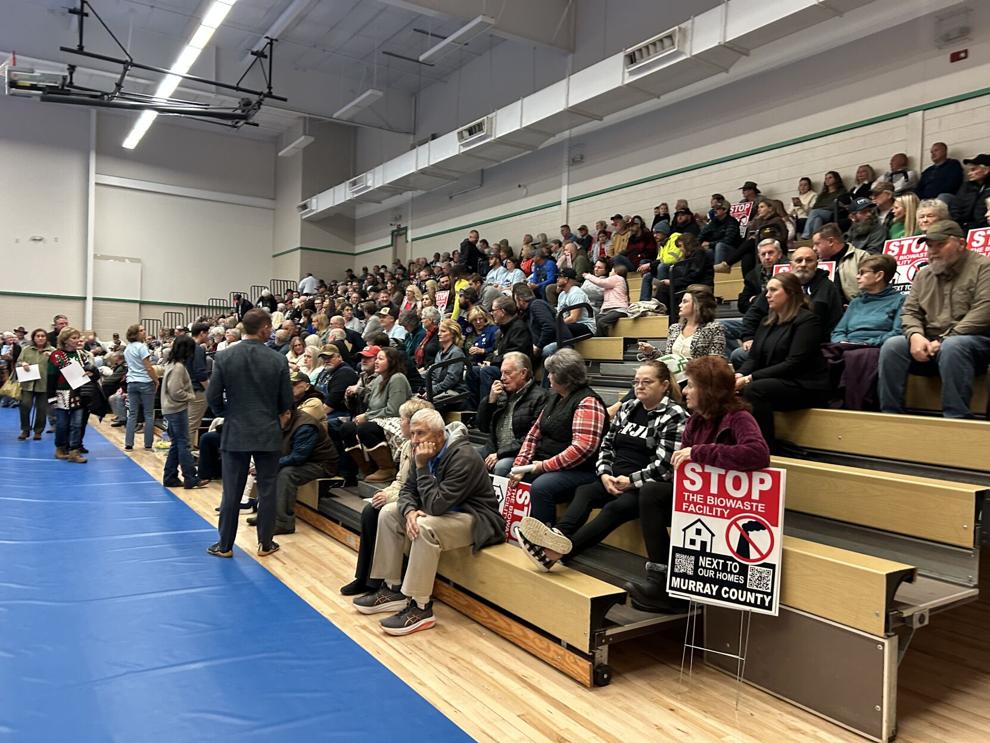
In a packed gymnasium thick with the scent of righteous fury and the echoes of rural defiance, U.S. Rep. Marjorie Taylor Greene stormed into a Murray County public hearing Thursday night like a force of nature, channeling the raw anger of hundreds of constituents dead-set against a proposed bio-waste facility they branded a “toxic time bomb” for their pristine Appalachian foothills.
The nearly five-hour showdown at the Murray County Recreation Department wasn’t just a local zoning spat—it was a microcosm of America’s deepening divide over green energy mandates versus the unyielding pull of small-town sovereignty.
Over 300 residents, many clad in camouflage caps and “Don’t Tread on Me” tees, spilled out of folding chairs and onto the hardwood floor, their voices rising in a cacophony of boos, cheers, and unfiltered outrage.
The FrankNez Media Daily Briefing newsletter provides all the news you need to start your day. Sign up here.
Seventy-six had signed up to testify against the project, but the real star was Greene, whose blistering takedown of the corporate backers left Vanguard Renewables’ representatives visibly shell-shocked.
At the evening’s tense climax, Murray County’s lone commissioner, Noah Bishop, delivered the knockout punch: He refused to reaffirm local approval for the plant to Georgia’s Environmental Protection Division (EPD), effectively slamming the brakes on the $20 million endeavor.
“If I had known the size, scope, and all the facts of this facility in February,” Bishop told the rapt crowd, his voice steady but laced with regret, “the initial consistency letter would’ve never been signed by me or by my office.
That was a failure on my part and I can assure you that never happen again.”
The EPD quickly followed suit, notifying Vanguard that permitting was on indefinite hold—a rare win for grassroots pushback in an era of aggressive renewable rollouts.
100,000 Tons of Waste Truckered In From Atlanta
The facility in question?
An anaerobic digester planned for a 10-acre plot along Barry-Bennett Road in southern Murray County, about 15 minutes south of this quiet lumber town of 8,500 souls.
Owned by Massachusetts-based Vanguard Renewables—a subsidiary of the investment behemoth BlackRock—the plant would gulp down up to 100,000 tons annually of animal manure, food scraps, and agricultural waste trucked in daily from Atlanta’s overflowing landfills and beyond.
Over weeks in oxygen-free tanks, the slurry ferments into methane-rich renewable natural gas, enough to power more than 5,300 homes yearly, plus nutrient-packed fertilizer for local farms.
Proponents tout it as a climate hero, slashing greenhouse gases from rotting waste.
But to Murray County’s cattle ranchers, well-water sippers, and stream-side anglers, it’s a recipe for disaster: 10 to 20 rumbling semis a day clogging narrow county roads, potential leaks poisoning aquifers, and a stench that could turn their “pristine beautiful land” into a no-man’s-land.
“Serious Risk to Clean Mountain Air and Well Water”
Greene, fresh off announcing her shock resignation from Congress amid a whirlwind of national headlines, made her first district appearance in weeks a spectacle of unbridled advocacy.
Her office had been “ringing off the hook” with complaints for months, she said earlier this week in a viral Facebook video that racked up over a million views.
“Vanguard Renewables owned by BlackRock is planning to build a biowaste facility 15 minutes south of Chatsworth in pristine beautiful Murray County!!” she warned, her eyes flashing with that trademark intensity.
“According to news sources, animal waste, food waste, manure and more will be trucked in to Murray County from Atlanta and all around to be turned into natural gas, but Murray County residents are outraged that it may pose a serious risk to the community’s clean mountain air, private well water, mountain streams, and could impact surrounding property values.”
Thursday’s hearing only amplified the alarm.
As Vanguard’s panel—a mix of suited execs, engineers, and a local farmer ally—fumbled through PowerPoint slides on “safe digestion processes” and “zero emissions,” the crowd erupted.

Boos drowned out explanations that the plant would create just six full-time jobs and steer clear of pharmaceuticals or human sewage.
One resident, Revla Biddy, a mother of three who swims with her kids in nearby creeks, didn’t mince words: “You are not bringing us anything. The pros don’t outweigh the cons. You’re talking about jobs, which you’re only bringing six, and building next to our creek where our kids swim.”
Greene Takes the Mic: “They Are So Damn Tired of This Shit”
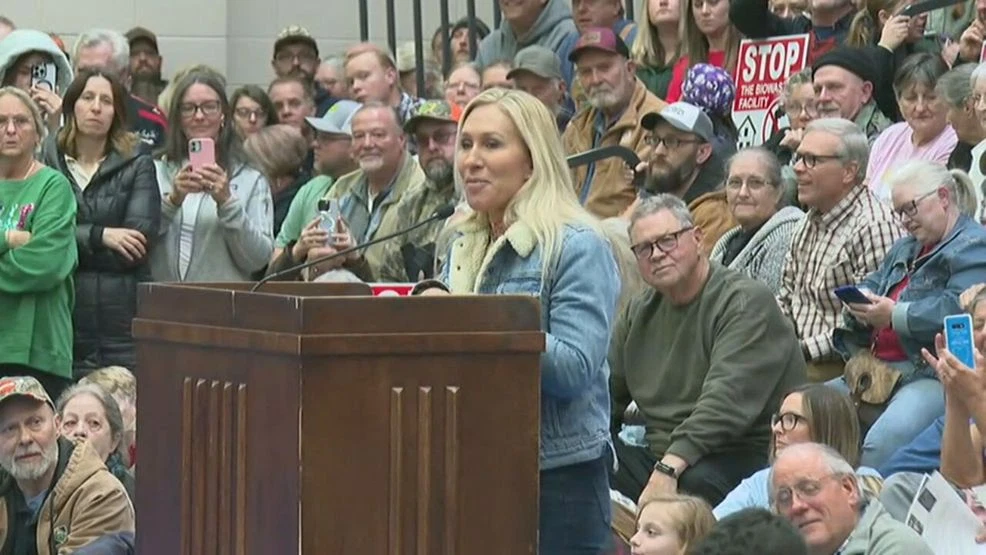
Enter Greene, microphone in hand, transforming the gym into her personal coliseum.
“Let me tell you about these people behind me,” she thundered, gesturing to the sea of fed-up faces.
“They are tired! They are so damn tired of this shit right here. Oh yes! They are fed up with it!… This is pristine beautiful land and don’t any one of you act like you care about the environment if you wanna build that piece of shit here.”
She skewered the presenters next: “While you lecture these people with your pathetic little slideshows about digesters and methane gas, the people sitting behind me, they own cattle, they grow their own food. They don’t need your damn jobs because you want to know something? They’ve already got jobs.”
The congresswoman didn’t stop at rhetoric.
She dropped a bombshell that sent shockwaves through the room: Recent resident sightings of American bald eagles on the site—federally protected under the Endangered Species Act—had triggered an active probe by the Georgia Department of Natural Resources (DNR).
“I’ve been calling my good friend at the EPA,” Greene revealed.
“Citizens here have spotted an American bald eagle, as a matter of fact, a couple of them. That’s right. This is where my role comes in. Those are federally protected species. DNR is currently actively looking for their nest.”
She hammered the point home: “You can’t build a house on a floodplain or wetland, and when there is a federally protected species, this is done. Absolutely done.”
Expert Claims “Very Difficult” for Leaks to Reach Water Table
The site’s placement in a known floodplain and wetland only deepened the skepticism.
Dr. Zachary Curtis, a Vanguard-hired expert, tried to assuage fears about groundwater risks—”It’s very difficult for the digester to get down to the water table”—but his words landed like pebbles in a hurricane.
Not everyone was against it.
Jim Freeman, whose family has tilled North Georgia soil since the 1800s and whose farm abuts the proposed site, defended the digester as a boon.
“Our family has farmed in North Georgia since the early 1800s,” he said.
“We believe that this agricultural digester will help lower the fertilizer cost and will be a good fit for our farm. The information we have seen shows that it is a natural, renewable fertilizer.”
When a heckler shouted, “What would your dad think?” Freeman shot back, “Yes my dad would like this thank you,” drawing fresh jeers.
Greene’s Final Warning: “Gigantic Uphill Battle” for Vanguard
Greene wrapped her remarks with a battle cry that left no doubt about the road ahead.
“You have a gigantic uphill battle on your hands. Gigantic,” she told Vanguard’s team.
“These people are not having it, and we don’t care how much money you spend on your attorneys. We don’t care. They don’t care.”
For Bishop, the decision to withhold reaffirmation wasn’t just political theater—it was a course correction.
His predecessor had greenlit the project in February based on what Bishop now calls misleading info from Vanguard about its scale.
The company, he argued, violated zoning by underplaying the industrial footprint.
With the EPD’s letter in hand, the hold could stretch months or morph into a permanent denial, pending eagle nest confirmation and further reviews.
Also Read: A DOJ Whistleblower Now Makes Revelation That Undermines the Judicial System’s Integrity